
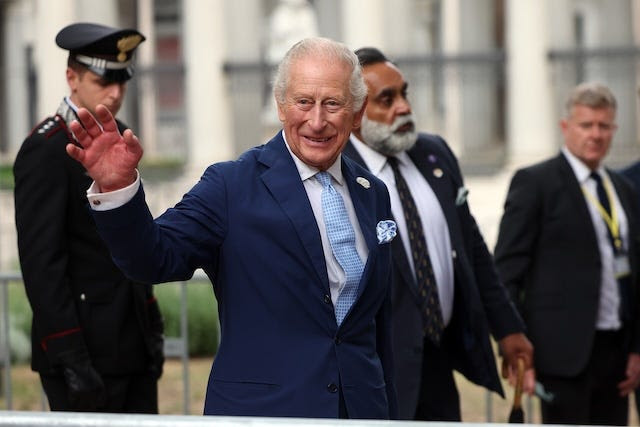
“Without my voice, and spirit, I am dust…” King Charles III
On Tuesday, April 28, 2026, King Charles III delivered a historic address to the 119th U.S. Congress. The speech marked only the second time the British Monarchy spoke to a joint session of congress. The first was delivered by Queen Elizabeth II in 1991. If you did not see the speech, here is a link to watch it. It is worth your time. I found it inspirational. I’ve watched it several times.
The King’s address was historic. It qualifies as such because it is an infrequent occurrence and because of the uniqueness of hosting such a prominent world leader. The speech and the visit will certainly be one of the highlights of 2026, a year of celebration for America. I’ve always been attracted to the grandeur of visits of heads of state, especially royalty such as the British Monarchy. They help me gauge the health of our foreign relations. They help me learn. I appreciate the special bond we share with other countries, especially the United Kingdom. Scotland is my ancestorial home.
I didn’t know what to expect from the King’s words. I’ve not seen him speak much over the years as he stood in the shadow of Queen Elizabeth II, but I was attentive, nonetheless. I adored the speech. It warmed my heart at a time when it needed warming. The King revived our two nation’s exceptional relationship, paid homage to our founding, and challenged our lawmakers to be good stewards of our American framework of government. It was heartwarming, emotional, and funny – the makings of a fantastic speech. It also offered plenty of lessons in leadership. Here are the King’s leadership lessons.
Presence. This I thought was the greatest lesson. His Majesty was calm and confident. He looked fatherly and fully engaged with his audience. His aura was one of humility, respect, gratitude, and joy of being in the moment. Though it is a technique of professional speaking, there were no great inflections in his voice. I thought this was appropriate. His messages were delivered unemotionally, with clarity and with eloquent and appropriate words and phrases. Leaders should emulate that. There is, indeed, a time for animation but this moment called for calm confidence – for gratitude. His presence kept me fully engaged. That’s how leaders operate.
Know Your Audience. I’ve always emphasized how leaders should know their people and the teams they engage to lead them appropriately. I thought the King was masterful with this. He was speaking to the very nation who rebelled against his 250 years ago. He went there right away acknowledging, “standing here today, it is hard not to feel the weight of history on my shoulder.” While the tension of our problematic 1776 relationship with Great Britan and the battles which raged in the years following are long behind us, this history was ever present like a proverbial elephant in the room. King Charles III was cautious and respectful of the pride Americans have over our founding and our cause. Respectful as he was, he did not speak ill of his own country. I found this most appropriate and superbly navigated. The King focused, as leaders should do, on that often invisible bond or force which unites us. Acknowledging our divergent beginnings, he lauded our two nation’s resolute relationship as “like-minded people,” sharing an “irreplaceable and unbreakable bond.” “Ours is a partnership born out of dispute, but no less strong for it,” he shared. His mastery of his audience – Congress and the American people will serve as an enduring lesson of leadership – know your audience and choose your words and your demeanor appropriately. Acknowledge disagreement and differences but focus on common ground.
Humor Works. Often, leadership calls for seriousness. However, humor does help. It can do wonders in the right moments. King Charles III included well-crafted and light-hearted moments to ease the tension and to maintain the attentiveness of his audience. He called 1776, “the tale of two Georges,” to the audience’s delight and followed by assuring everyone he was indeed present to spread goodwill. “Please rest assured, I am not here as part of some cunning rearguard action,” he joked. The chamber erupted in laughter. His punchlines were delivered with a straight face and with his distinct royal British brogue which made his humor even more effective. They eased the tension one might feel when being spoken to by a leader of his stature. His Majesty’s humor also revealed a leader who was ready and willing to let his guard down. It was respectful and well timed. Humor works. Where you can drop it in during your days leading and especially during a speech, you ought to emulate the King.
Pass Lessons/Call Your People To Action. King Charles III reminded us, as teachers and leaders do, of our history, our founding, its principals, and our duty to uphold them. His Majesty spoke of the “inheritance of the British Enlightenment, as well as the ideals which had an even deeper history in English common law and Magna Carta.” Magna Carta was a charter of liberties dating back to 1215 adopted in the creation of our own American liberties. One of the lesson’s the King underscored from Magna Carta is “the principle that executive power is subject to checks and balances.” While he spoke of our known history, he crafted his words and stories as lessons – reminders of our duty as modern citizens. His address was a call to action for Congress – for all of us as Americans to carry forth the vision of the Founding Fathers in alliance with the United Kingdom.
You need not be a king to lead effectively. You don’t require the pomp and circumstance emblematic of a state visit to have similar impact to your people and your audience. You’ll undoubtedly encounter divergence as you lead disparate people and organizations. Emulate his Majesty in your approach to leadership. His address to the 119th Congress is a fine example – a lesson in leadership.
Make it Personal!
