

Welcome to installment number four of my leadership celebration of America 250. If you are just joining me, I invite you to visit my earlier installments found right here in my Substack account. This year along with celebrating my country’s 250th Birthday – the Semiquincentennial in grand fashion at the beach with family and friends, I’ll celebrate 10-years since my retirement from a 27-year military career. This year I’ll reunite with paratroopers I fought with in Afghanistan for a ceremony honoring our unit. A baby will be born; a parent will turn 80 and I’ll celebrate my forty year high school graduation. I might even get a tattoo! I have much to celebrate this year but the Semiquincentennial eclipses all of it. Because of this, I’ll celebrate the best way I know how – writing about leadership. Back to our topic.
We are indeed the beneficiaries of the wisdom, courage, and leadership of our founding fathers. We are the beneficiaries of their virtue. As I pondered 2026 late last year, I thought about my writings – where I would take them, specifically, what topics I’d cover to celebrate America’s 250th birthday. I knew before I wrote the first sentence there would be a surplus of leadership lessons to recall and refresh for the America we live in today – for leadership. I stumbled upon this quote from John Adams and knew it was worthy of a rebirth. “A republic cannot endure without virtue.” Nor can leadership survive without virtue.
Merriam Webster provides a fitting collection of virtue definitions – useful as a reflection for leaders surveying their own behavior and what truly drives them. Here they are:
Virtue noun:
1: morally good behavior or character. those who lead lives of virtue
2: a good and moral quality. Patience is a virtue.
3: the good result that comes from something. the virtue of hard work
4: an advantage or benefit. One of the virtues of this job is the flexible hours.
5: strength or courage: valor
6: a capacity to act: potency. She had the virtue to confront her bully.
Do you behave and operate with morality, possess good qualities, and define and produce good and benefit in what you do? Are you courageous and do you have capacity to act in a virtuous way? Are the leaders you lead and grow virtuous? Can they be taught virtue? Do you hold them to account using the definitions of virtue as your tenets? These are all leadership questions that demand answers. Building on these definitions, Christian theology offers the “Four Cardinal Virtues,” of prudence, justice, fortitude, and temperance to further our understanding of virtue and how a nation and its leaders must possess them to survive. The diagram below from the Hugot Seminarista, a Catholic social media ministry illustrates these four virtues appropriately.
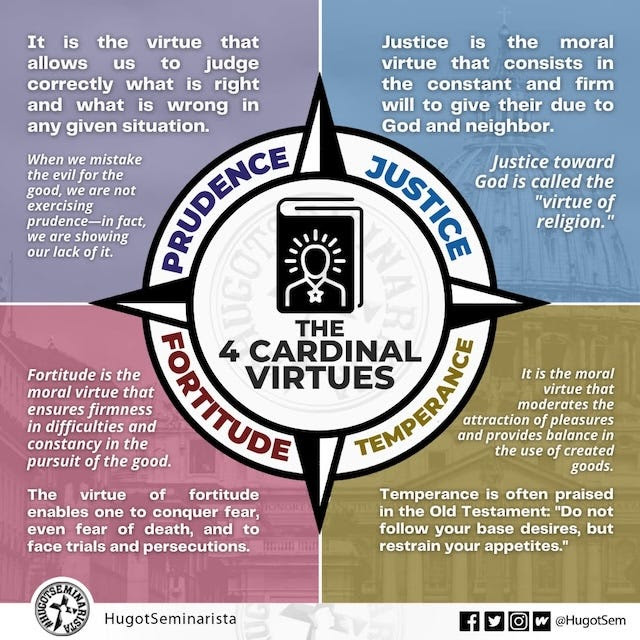
Survival was foremost in the minds of our founding fathers, notably John Adams, who is credited for his pursuit and perseverance in crafting the vision of America and our founding documents. He and the original signers of the Declaration of Independence knew they and their families faced their demise taking such a stand. Moreover, they knew the republic – the great American experiment may not survive. Benjamin Franklin famously cautioned, “… a republic, if you can keep it,” in 1787 following the Constitutional Convention in Philadelphia. Adams argued the same when he offered virtue as a requisite trait for America to keep its newly formed republic. I offer the same trait for leadership.
Some may believe virtue in leadership is implicit. Indeed, there a bad actors in leadership and in society but aren’t most leaders virtuous? As an optimist, I do believe most leaders do possess an appropriate level of virtue. I believe most citizens are virtuous or strive to be. However, societal pressures, immoral temptations, the demands of business and even the forces of evil invade virtue at every opportunity. Leaders must guard against them. The clearest example I can provide is the pursuit and lure of money. As a small business owner my business must have money to survive. If cashflow is not in balance, the business may fail. Furthermore, to scale my business and to remain competitive means I must chase the next sale and find ways to conserve funds. The money demands of my business come at the expense of virtue. Money does not care. The business does not care. It demands what it demands agnostic of the people it impacts – agnostic of virtue. John Adams captured it best in this piece by Edward Saltzberg, a contributor to the Fulcrum a political commentary site. I’ll add my leadership passages to it.
“Adams distinguished between subjects (employees) and citizens (teammates or people). Subjects were ruled. Citizens participated. But citizenship (leadership) required more than casting a vote. It demanded habits that sustain a free society (a healthy engaged company): honesty, moderation, service, and fairness. A republic (a company or organization) cannot rest on the hope that enough citizens (leaders, teammates, or people) will voluntarily restrain themselves. History shows that when virtue fails, only clear rules (leadership) —laws (leaders) that promote fairness and institutions that protect the public good—can prevent private power from overwhelming democracy itself.”
Virtuous leaders are the sentries who constantly stand guard promoting and protecting citizen or employee participation, honesty, moderation, service, and fairness. They exercise and enforce restraint. Adams continues, “without these guardrails, inequality grows unchecked, cynicism deepens, and democracy itself becomes vulnerable to collapse.” So does an organization. Leaders build and maintain virtuous guardrails.
One could challenge the virtue of the Founding Fathers who birthed a nation which permitted slavery. That is a fair challenge, but they formed the philosophy and the American institutions upon which slavery was eventually abolished. That, in this author’s opinion, is virtuous enough for the lessons of leadership. They poured the virtuous foundation upon which America travels on its “long road to freedom,” as former Secretary of State Codoleezza Rice shares in her book, “Democracy.” Leaders pour the same foundation for their teams through vision – an inspiring and aspiring (and virtuous) view of the future state of their organization.
Good leaders are students of leadership. They engage in introspection assessing how they lead. They use the definitions and concepts of virtue to measure their own leadership and that of their people. Leaders are the keepers of virtue within themselves and the teams and organizations they lead. They are conscious, more than others, that their people and their teams “cannot endure without virtue. Nor can America.
Happy Birthday America!
Make it Personal!
Rob Campbell
Read more from Rob here.
